


Jun 2017
And the winner of ‘Marketing Strategy of the Year’ is…
Written by Paul Maher
Many marketing agencies struggle to gain recognition for strategies that deliver meaningful results. Positive Marketing won the Marketing Strategy of the Year award through an innovative, client-focused campaign. This article explains the approach we used, the challenges we overcame and the results it achieved
Taking an idea from your head to the page is one of the key challenges we face daily in marketing. Many have the ideas, a few of us can write and some can even execute on a plan, but it takes time. It is therefore all the more gratifying when ideas become reality and bear fruit and marketing strategy becomes content which creates leads which convert into revenue. Dreaming big needs to land big sales. Best never to forget that.
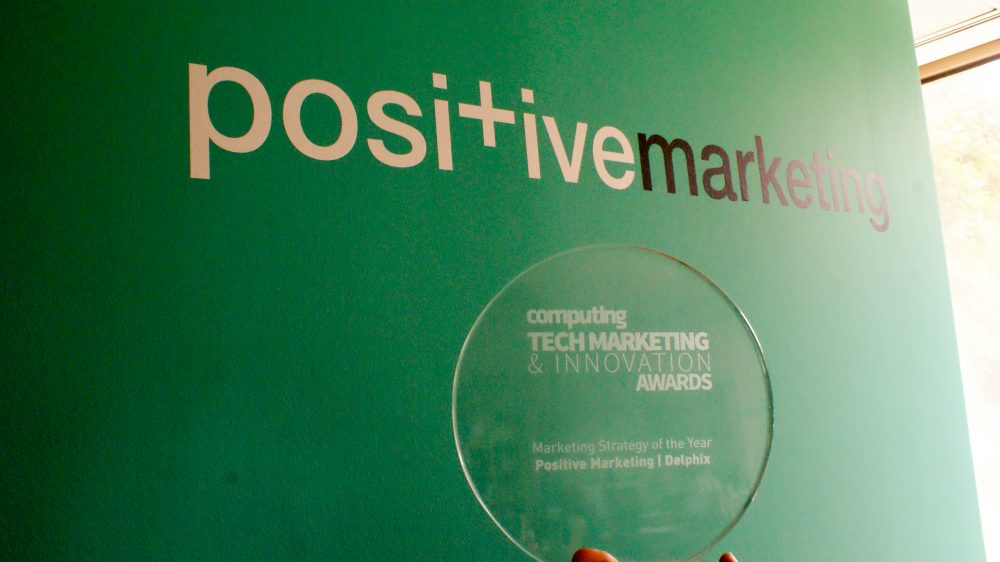
For Positive Marketing, founded in a recession from a bedroom which doubled as a nursery, it has taken eight long years to achieve the third party recognition we always hoped we deserved. So it was on a sultry afternoon atop the flamingo-adorned finery of Kensington Roof Gardens that our work with Delphix brought us this handsome trophy – Computing’s Tech Marketing & Innovation award for Marketing Strategy of the Year.
So how did we finally get there? It was not dreams alone ‘wot won it’. Rather it was intense client-focus working to a very tight brief to deliver leads from a tightly-defined target audience. Our challenge was to bring the benefits of Delphix’s DataOps technology to the time-pressured compliance teams nestling within Europe’s financial services sector.
Cracking the code
The hard-to-find professionals who sit somewhere between traditional IT specialists and legal eagles, needed to be persuaded to consider a fresh approach, from a vendor they were most likely unaware of.
Using the UK’s Highway Code as a style touchpoint and with copy that wove in the ‘journey to compliance’ tightly with Delphix’s message we created a perfect ‘core asset’. To make sure readers took value away, bespoke research and redacted case studies from their peers were embedded. The result was unlike anything seen before in the Governance, Compliance and Risk (GRC) sector before, creating massive stand-out.
From this the campaign team rallied to create nurture streams to ‘chivvy’ those considering new data governance solutions to the challenge. This involved custom blogs, emailers and promotion to the financial services titles most relevant for the target customers. The results followed, including over 25% more leads than targeted, sales meetings with large European banks and culminating in the award win for Positive. All thanks to a client with the vision to back it’s very different approach.
On to the next one
While it is gratifying to stare at the trophy and a matter of pride for the team, the new accolade will not go to our heads. We have celebrated and dissected the elements which came together so successfully, and are already deep into the planning for its successor. We know it is only by hard work we can hope to make it less than eight years before our clients see their campaigns the spotlight.
You see, we are all about turning the winning campaigns in our heads into results. Ideas are cool, awards are great, action speaks louder than either. We are already working on our next award-winning campaign.
TL;DR
Positive Marketing’s award-winning strategy combined client-focused campaigns with innovative marketing approaches to overcome key challenges and achieve success. This article explains the strategy, the work behind it and the lessons it offers for effective marketing.
F&Q
What award did Positive Marketing win? Positive Marketing won Computing’s Tech Marketing & Innovation award for Marketing Strategy of the Year for its work with Delphix.
What was the campaign’s main challenge? The campaign needed to make Delphix’s DataOps technology relevant to busy compliance teams in Europe’s financial services sector.
What made the marketing strategy effective? It combined a tightly defined audience, a distinctive UK Highway Code-inspired core asset, bespoke research, peer case studies and targeted nurture content.
What results did the campaign achieve? The campaign generated more than 25% more leads than its target and secured sales meetings with major European banks.